
A Neighborhood with a Distinctive Sense of Place
Lake Isle is one of New Rochelle’s quieter and more spacious neighborhoods, tucked along the city’s northern edge near the Eastchester border. Known for its leafy streets, generous properties, and proximity to the former Lake Isle reservoir, the area feels less like a traditional urban neighborhood and more like a wooded residential retreat.
Its history is closely connected to New Rochelle’s larger story: the transformation of a farming community into a suburban city, the arrival of commuter rail and improved roads, and the steady conversion of estates and open land into residential neighborhoods. What makes Lake Isle special is that traces of each period remain visible in the landscape. Old stone walls, mature trees, winding roads, and substantial homes all hint at an earlier New Rochelle.
From Huguenot Settlement to Northern New Rochelle
New Rochelle’s European history began in 1688, when French Huguenot families settled land purchased from John Pell. The community was named for La Rochelle, the French port city from which many of the settlers came. In its early centuries, the area that would eventually include Lake Isle was largely rural, with farms, wooded tracts, streams, and family estates spread across the northern part of town.
The early settlement was concentrated closer to today’s downtown and waterfront, but the city gradually expanded northward. Farms supplied food to local residents and nearby New York markets, while country estates offered wealthy families an escape from the increasingly crowded city. Roads that are now busy suburban thoroughfares began as rural routes connecting farms and villages.
The Lake Isle area developed slowly because its natural landscape was not easily suited to dense construction. Its rolling terrain and wetland areas encouraged a more spacious pattern of development—one that still distinguishes it from the compact blocks closer to downtown.
How Lake Isle Got Its Name
The neighborhood takes its name from the body of water historically known as Lake Isle, located near the New Rochelle–Eastchester boundary. The name is also associated with Lake Isle Country Club, a major recreational institution on White Plains Road in Eastchester.
The exact boundaries of the Lake Isle neighborhood can vary depending on whether one is speaking geographically, historically, or in real-estate terms. In general, the New Rochelle portion lies along the eastern side of the former reservoir and extends into a residential area that continues naturally across the municipal line into Eastchester. Local descriptions commonly identify it as a neighborhood of lakefront homes, estates, and wooded properties. ([en.wikipedia.org](https://en.wikipedia.org/wiki/List_of_neighborhoods_in_New_Rochelle%2C_New_York?utm_source=openai))
That shared landscape is important. Although municipal borders divide New Rochelle and Eastchester, the lake, roads, and recreational facilities have long connected the two communities. Residents experience the area as one continuous northern suburban setting rather than as two sharply separated places.
Water, Recreation, and the Country-Club Era
By the late nineteenth and early twentieth centuries, northern New Rochelle and neighboring Eastchester were becoming increasingly attractive to affluent New Yorkers seeking country living within commuting distance of Manhattan. New Rochelle’s rail connections and improved roads helped turn former farmland into a desirable suburban landscape.
Lake Isle became part of that recreational tradition. The modern Lake Isle Country Club occupies a large former private-club property on White Plains Road. Eastchester purchased the 116-acre site in 1979 and converted it into a public recreational facility with golf, tennis, swimming, and other amenities. Although the facility is in Eastchester, its name and location have helped define the identity of the surrounding New Rochelle neighborhood for generations. ([lakeislecountryclub.com](https://lakeislecountryclub.com/about.html?utm_source=openai))
The country-club tradition reflects a broader Westchester pattern. Private clubs, golf courses, and landscaped estates emerged as transportation made it possible for business leaders and professionals to live outside New York City. In Lake Isle, recreation and residential life developed side by side, creating the spacious, park-like character many people still associate with the area.
Streets and Landscapes That Tell the Story
A walk or drive through Lake Isle reveals a neighborhood shaped more by landscape than by a formal commercial center. White Plains Road serves as the most recognizable regional artery, while smaller residential roads lead toward lakefront properties and wooded sections.
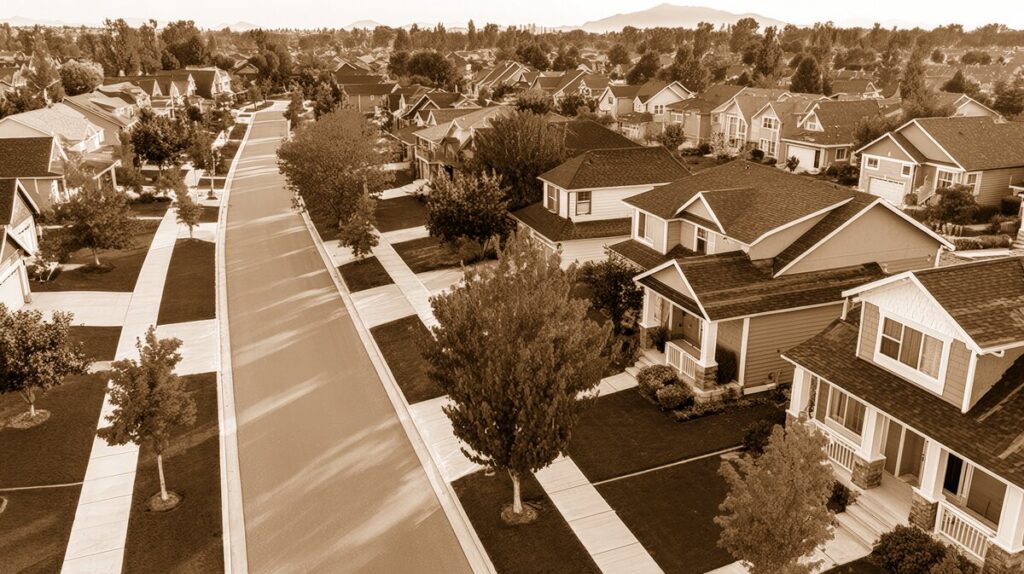
The neighborhood’s visual character comes from its mature trees, broad lots, and varied architecture. Some houses reflect the Colonial Revival and Tudor Revival styles popular in the early twentieth-century suburban building boom. Others are later ranches, split-levels, and custom homes that illustrate the postwar expansion of Westchester.
Unlike New Rochelle’s historic districts such as Rochelle Park and Rochelle Heights, Lake Isle is not primarily known for a uniform planned layout or a concentrated collection of landmark buildings. Its heritage is more dispersed. It survives in property lines, stonework, old trees, surviving estate houses, and the relationship between roads and open land.
That is part of the neighborhood’s charm. In Lake Isle, history is often encountered at the edge of a driveway, behind a hedgerow, or in the shape of a road that follows the land instead of cutting straight through it.
New Rochelle’s Suburban Transformation
The decades after World War II brought major changes to Lake Isle and the surrounding northern neighborhoods. As automobile ownership became widespread, homes were built farther from train stations and traditional business districts. Families sought larger houses, private yards, and access to parks and recreational facilities.
New Rochelle’s northern neighborhoods benefited from this demand. Older farms and estates were subdivided, while new homes filled in previously undeveloped tracts. The result was a landscape that blended earlier country properties with mid-century suburban construction.
Even as the city grew denser in its downtown core, Lake Isle retained a low-density residential identity. Its location near Eastchester, Scarsdale, and major Westchester roads made it convenient without sacrificing the feeling of being removed from the center of town.
Nearby Institutions and Historic Connections
Lake Isle’s heritage is best understood in relation to New Rochelle’s broader network of historic places. The neighborhood is within reach of institutions and landmarks that help explain the city’s development, including the New Rochelle Public Library’s local-history resources, the Thomas Paine Cottage, and the historic neighborhoods around North Avenue and downtown.
The New Rochelle Public Library maintains maps, photographs, neighborhood materials, and other resources documenting the city’s growth from the nineteenth century onward. These collections are especially valuable for understanding how rural areas were gradually divided into residential communities. ([nrpl.org](https://nrpl.org/research-and-learning/new-rochelle-history/?utm_source=openai))
The city’s Historical and Landmarks Review Board, established in 1985, has also helped preserve and interpret New Rochelle’s historic buildings and districts. While Lake Isle’s heritage is not centered on one landmark structure, the city’s preservation efforts provide a larger context for appreciating its older homes, landscapes, and architectural traditions. ([newrochelleny.gov](https://newrochelleny.gov/101/Historical-and-Landmark-Review-Board?utm_source=openai))
Lake Isle Today
Today, Lake Isle remains one of New Rochelle’s most distinctive residential settings. It is valued for quiet streets, greenery, substantial homes, and the sense of continuity created by the lake and surrounding recreational land.
The neighborhood has changed, but not completely. Farms have disappeared, estates have been divided, and modern houses have joined older ones. Yet the essential character remains: water nearby, trees overhead, and a built environment shaped by the desire for space and connection to nature.
For longtime residents, Lake Isle’s appeal is found in those everyday details—the changing color of the woods, the quiet of a residential road, the sight of older stonework, or the familiar route along White Plains Road. It is a neighborhood where New Rochelle’s rural past and suburban present still meet.
Lake Isle may not announce its history with a single grand monument. Instead, its heritage is written across the landscape. The neighborhood’s name, its lake, its homes, and its enduring greenery all tell the story of how northern New Rochelle grew from farmland and estates into one of the city’s most treasured residential communities.